
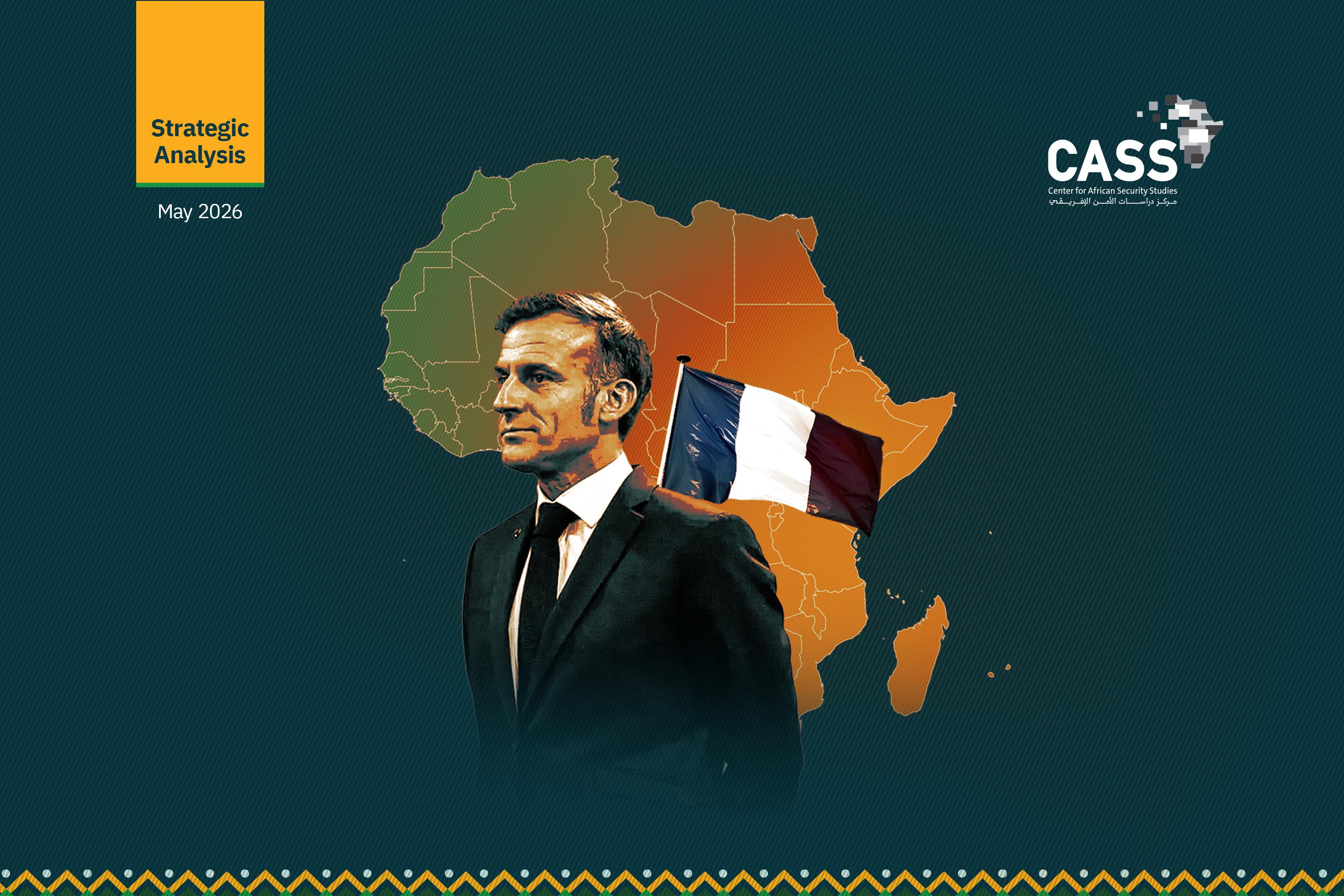
The African tour launched by French President Emmanuel Macron on May 9, 2026, represents a new attempt to reposition France within the African continent following years of accelerating decline in French influence, particularly in the Sahel and West Africa.
The tour comes at a moment of acute sensitivity for Paris, amid the growing presence of Russia, China, and Turkey across Africa, the rise of anti-French sentiment in a number of Francophone countries, and the sweeping security transformations unfolding across the continent — from Sudan and the Horn of Africa to the Sahel and West Africa.
The tour began in Egypt before Macron moved on to Kenya and then Ethiopia — three countries that clearly reflect the shift Paris is seeking to entrench in its Africa policy. Rather than focusing exclusively on the traditional Francophone sphere, France is seeking to expand its presence in East Africa and the Red Sea, and to engage with African regional powers that have not historically been tied to direct French influence.
The choice of Egypt as the first stop carries clear political and security dimensions. Cairo represents for Paris a pivotal partner on the files of the eastern Mediterranean, the Red Sea, Gaza, and Libya, and serves as an important gateway toward North Africa and the Horn of Africa.
The visit focused on strengthening political and economic ties, alongside the inauguration of the new campus of the Francophone Senghor University in Alexandria — a step that reflects a French attempt to preserve the instruments of cultural and linguistic influence within the continent, in parallel with political and security engagement.
The visit also came against a backdrop of growing French interest in maritime security in the Red Sea and the Strait of Hormuz, particularly amid escalating regional tensions and their impact on European trade.
Kenya, for its part, represents the most symbolically significant stop of the tour, as it hosts the Africa–France Summit — held this time in an English-speaking country rather than in a traditional Francophone space. This shift reflects Paris's recognition that the old "France–Africa" model has lost much of its effectiveness, and that France needs to build broader partnerships grounded in economics, technology, energy, and maritime security, rather than relying on historical and colonial-era ties.
The choice of Nairobi is also tied to Kenya's rising stature as an economic and political hub in East Africa and an important partner on regional security issues, the Red Sea, and the Indian Ocean. Coverage surrounding the summit indicates that the core files on the agenda include security, the energy transition, reform of the international financial system, and investment in infrastructure and technology.
Ethiopia, meanwhile, represents a complex strategic file for France. Paris regards Addis Ababa as a pivotal state within the Horn of Africa and the African Union, despite the internal tensions and war the country experienced in recent years. France is seeking to maintain its relations with the Ethiopian government, particularly amid intensifying international competition for influence in the Horn of Africa and the overlapping dynamics of the Red Sea, Sudan, and Somalia files. Paris is also seeking to leverage Ethiopia's geopolitical position to assert its presence in a region that has become the site of fierce competition among multiple international and regional powers.
From a political standpoint, the tour clearly reflects Macron's attempt to present France as a "new" partner for Africa, distancing it from the image of a traditional colonial power. In recent months, Macron has repeatedly spoken of the need to "rebuild" the relationship with Africa and to turn the page on "Françafrique," amid a growing recognition within Paris that the previous approach — based on direct security and military influence — is no longer sustainable.
Yet this discourse faces significant challenges on the ground, particularly in the Sahel states, which have witnessed the withdrawal of French forces and the rise of military regimes hostile to Paris, backed by an escalating sovereigntist and populist narrative against French influence.
On a practical level, Macron appears to be pursuing several parallel objectives through this tour, most notably the re-anchoring of French presence in East and North Africa, the reinforcement of economic and investment partnerships, the containment of France's strategic retreat on the continent, and the extension of French influence beyond the traditional Francophone sphere.
Paris is also seeking to present itself as a European partner capable of working with Africa on security, energy, migration, and technology files — at a time when Europe faces growing challenges linked to Red Sea security, irregular migration, and international competition over African resources and markets.
Nevertheless, what the tour can practically achieve appears relatively limited in comparison to the scale of the transformations underway across the continent. It is unlikely that Paris will succeed in recovering its former influence, particularly in West Africa and the Sahel, where France now faces increasing political and popular rejection.
However, the tour may help consolidate a new French model built on flexible economic, cultural, and security partnerships, with a focus on East Africa and the Red Sea as the most viable space for French repositioning in the period ahead.
Paris is also expected to use the Africa–France Summit in Kenya to reformulate its discourse toward the continent, emphasizing "balanced partnership" over traditional influence — even if African skepticism toward French intentions remains present to varying degrees.